
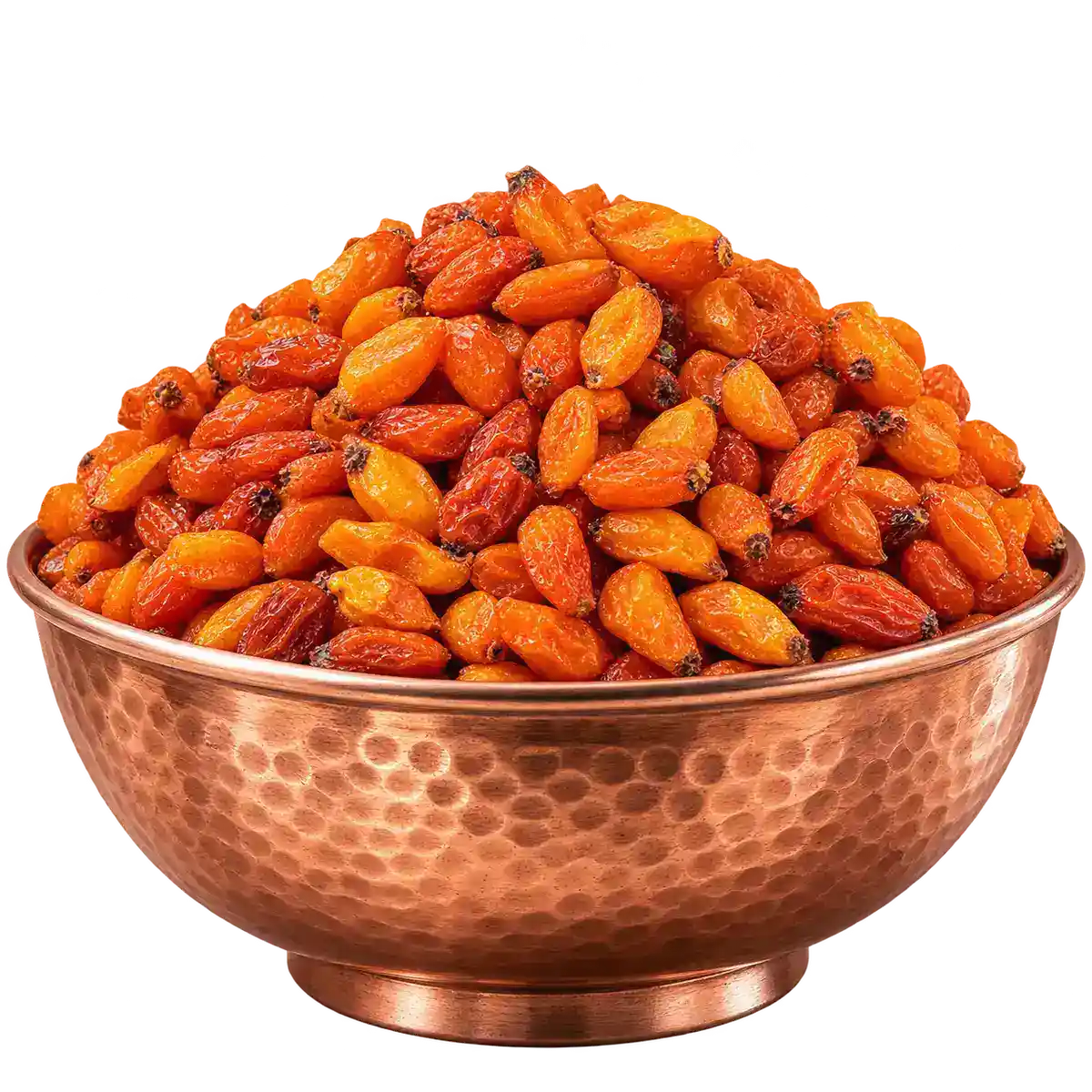

What Is Sea Buckthorn, the Leh Berry?
Sea buckthorn is a thorny bush with small orange berries, smaller than a pea. In Ladakh people call it Leh Berry. In books and research papers you will see the name Hippophae. The berry is very sour. Nobody eats it fresh like a sweet fruit, it is dried, or made into tea, juice, pulp and oil.
The bush grows wild in the cold dry valleys, on river beds and rocky ridges, where winter goes far below zero and very little else can grow. Its roots hold the soil, so local people also protect it for this reason.
Where It Grows, and What People Mean by Kashmir
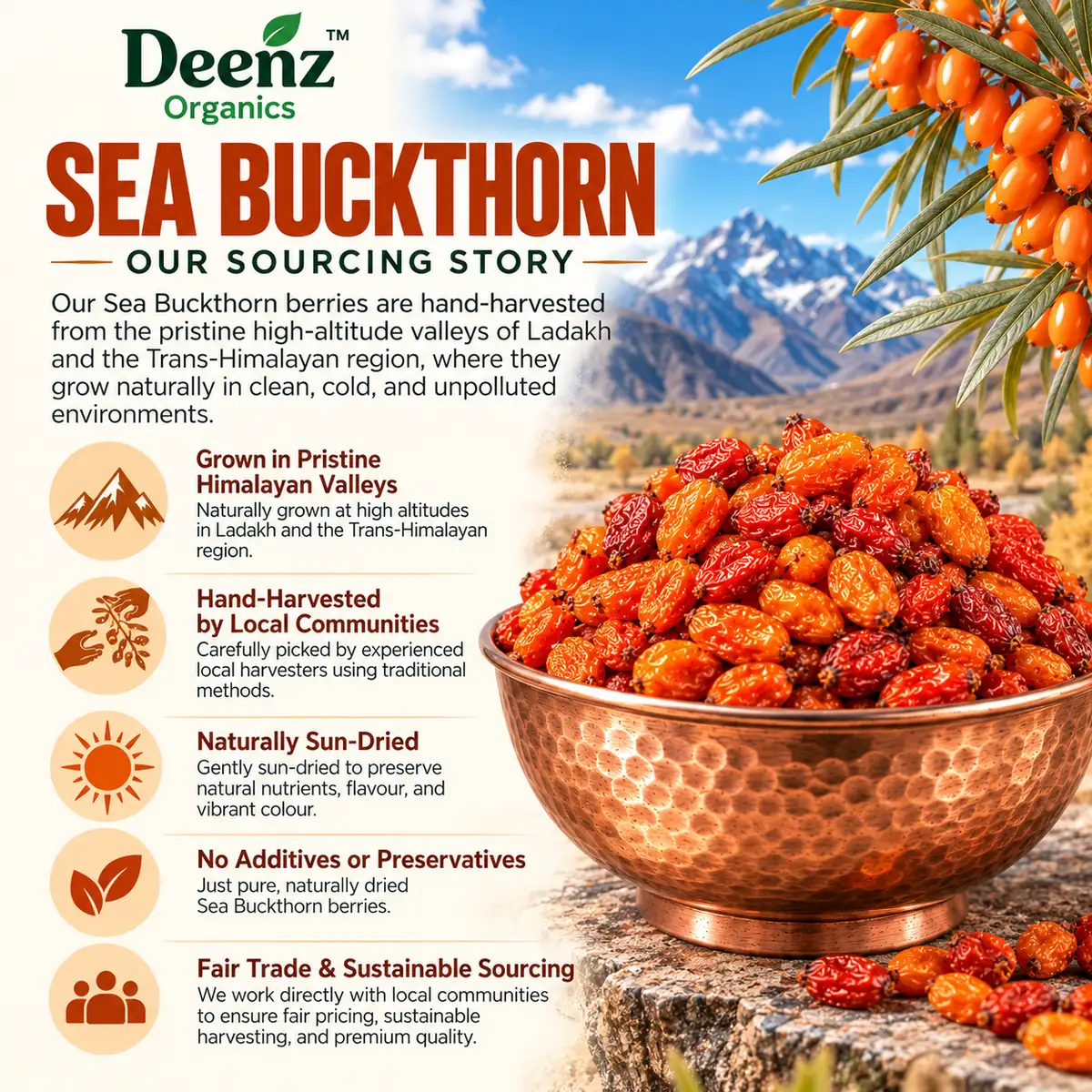
A lot of people search "Kashmir sea buckthorn". We want to tell you the real picture, because many sellers make this confusing. In India, most sea buckthorn grows in Ladakh. Ladakh has more than 70 percent of the total area under this plant in the country.[2] Some more grows in Lahaul-Spiti, Kinnaur and other high Himalayan areas.
Our berries come from the high valleys of Ladakh and the Kargil side, at around 11,000 feet and above. We are in Kashmir, we receive the berries from there and send them to your home from here. So the plant is Ladakhi, and the packing and dispatch is from Kashmir.
Ladakh sea buckthorn also got its GI tag in November 2023, registered with the Department of Industries and Commerce, Ladakh.[1] So if any seller says "Kashmiri sea buckthorn", ask him one simple thing: which valley did it come from? A real seller will tell you.
How the Berries Are Collected
Harvest time is September and October, when the berries turn deep orange.[5] It is not easy work. The branches are full of sharp thorns, the berries are small and they hold tight to the branch. Pickers go to the rocky river beds and cold ridges and take the berries by hand, or shake the branch over a cloth sheet. Hands get cut, and it takes many hours to fill even one bag.
Because of this, most of the crop is never picked. The Ladakh administration recorded about 666 tonnes collected in 2024 and 315 tonnes in 2023, and said this is only 5 to 6 percent of the crop.[3] A newer report from September 2026 gives a different figure, about 15 percent used.[4] The numbers are not same in every report, but the story is same everywhere. Most berries stay on the bush.
How We Dry It
A fresh berry is juicy and very delicate, it spoils fast if not dried or pulped quickly. Ours are washed in clean glacial water and then dried slowly under the mountain sun, in shade and sun, so the natural oil inside the berry stays with it. We do not add sugar, sulphur or any colour.
What you receive is a dull dark-orange berry, a little wrinkled and a little sticky, and the taste is sharp sour. This is how real dried sea buckthorn looks. If a berry is shiny, bright and soft like a raisin and tastes sweet, somebody has soaked it in sugar syrup. Kept in an airtight container, away from sunlight, our berries stay good for 12 months from harvest.
Why Everybody Is Asking for It Now
Ten years back, very few people outside Ladakh knew this berry. In the early 2000s, DRDO developed the technology for sea buckthorn juice, and that was the first big turn.[5] After that came the GI tag, and Leh district chose sea buckthorn as its One District One Product. In his Mann Ki Baat, the Prime Minister called it a modern "Sanjeevani", and after that the interest went up all over India.[4] Companies outside Ladakh already buy the pulp from there for making their own products.[2]
In September 2026, Ladakh held its first international sea buckthorn conclave in Leh. About 20 big buyers and 120 small entrepreneurs and self-help groups came, and the government doubled the minimum price paid to pickers, from ₹150 to ₹300 per kg of fresh berries.[4]
In our view, this tells you two things. The demand is growing fast, and the supply is small because picking is so hard. When this happens, the market fills with mixed and sweetened product. So it is worth knowing how to check before you buy.
How to Check If Sea Buckthorn Is Real
First, taste it. Real sea buckthorn is sharp and sour, it makes your face tight. If it tastes like sweet raisin, there is sugar in it. Second, read the ingredients. There should be one thing only, sea buckthorn berries. Third, ask the valley and the harvest year. Real berries are picked in September and October, and the seller should be able to say Ladakh, Kargil or Nubra without thinking much.
Fourth, look at the colour. Real dried berries are dull dark orange, not shiny and not neon. Fifth, look at the price. This year the fresh berries alone are bought at ₹300 per kg, and dried berries weigh much less than fresh ones. So if somebody is selling dried sea buckthorn very cheap, you should ask why.
How to Use Dried Sea Buckthorn
Start with 4 or 5 berries, because the taste is very strong. After some days you can take 8 to 10 berries daily. You can chew them with water, or soak them overnight in warm water and drink it in the morning. Some people put them in warm water with a spoon of raw honey as a mountain tea, and some crush a few berries over curd or oats.
Sea buckthorn is a food, not a medicine. If you take regular medicine, or you are pregnant, please ask your doctor before making it a daily habit.
Order Sea Buckthorn from Deenz
If you want to try, you can see pack sizes of 250 g, 500 g and 1 kg, with price, on our Himalayan Sea Buckthorn Berries page. We send it from Kashmir to your home anywhere in India.